
Caribbean Traffic Crash Investigation Symposium 2026:
Using Technology for Safer Systems
Regional Transport Research Conference 2026:
Perspectives on Conflict in Transport and Mobility
Supported by:


Join us for a leading conference bringing together professionals across the region to address critical issues in transport. This event will feature sessions led by experts on innovative solutions, research, and discussions on pressing challenges in transport systems and mobility.
About TAMPER Consulting
Established in April 2024, TAMPER Consulting focuses on developing solutions for mobility and safety issues in transportation, and delivering specialised training in traffic safety, driver behaviour, and traffic crash investigation and reconstruction in the Caribbean Region.
TAMPER Consulting is equipped with the requisite technical competencies to address a wide range of needs, offering research, analysis, and consulting services to address policy, planning, implementation and operational issues in transport and mobility, and support the needs of government, industry, academia, or individuals.
The schedule of workshops and other events covers a range of relevant and pertinent topics within the transportation space, with a focus on safety issues, tailored and customised for clients in Jamaica and the Caribbean. Other specialised services include parking surveys and analysis, and traffic impact assessments for large developments.
The conference and symposium are hosted by TAMPER Consulting, which is based in Kingston, Jamaica, and has a core mission to make a positive contribution to traffic and transport safety and operations in the Caribbean and the wider region of the Americas. We believe that it is important to bring the many voices together in an environment where the various perspectives can be shared and appreciated, and the knowledge used to build a better way forward.
Location:
Units 15-16 TAJ Business Centre
105k Red Hills Road
Kingston, Jamaica W.I.
Introduction
The Regional Transport Research Conference (RTRC) held in February 2025 in Kingston Jamaica, with the theme “Perspectives on Conflict in Transport and Mobility” set the foundation for this annual event. At many levels, conflict permeates the sector and creates situations in which avoidable obstacles are frequently encountered. Increased understanding of other perspectives is but one step towards an environment in which effective solutions can be developed and implemented.
Views expressed in the panel discussions and the presentations made at the RTRC 2025, provided valuable insights about several aspects of matters related to transport. The success of the event is evidence of the interest of persons (in industry and academia) to engage in meaningful research and active dialogue about current and pending issues for the betterment of the region, and justifies continuing efforts to build on the initiative.
The Caribbean Traffic Crash Investigation Symposium: Cracking the Code with Technology was held immediately before the RTRC, with synergies feeding into the success of both events. In the coming years, the CTCIS/RTRC will be a vibrant and interactive source for thought leadership and expression in the selected subject areas, and the next staging of the event(s) will be on February 23-27, 2026, in Kingston, Jamaica.
Background
Conflict cuts across and opens up opportunities for reflection, because it occurs at different levels and does not always show up in the same way. It often starts with what might be considered as friction, where there are differences in objectives, ideologies, or authority. Within the transport and mobility sector, conflict arises in administrative arrangements, resource allocation, the demand or need for services, and the interests of individual users.
Despite the negative effects typically associated with conflict, it must be embraced, explored, and interrogated because it drives change, promotes innovation, and demands action to resolve challenges.
Diversity of perspectives fosters a freedom of expression that allows recognition of, and acknowledges differences in view about the roles, responsibilities, actions, and relationships that may contribute to conflict. Whether the dynamics between transport and other areas are cooperative, competitive, dependent, supportive, or complementary, there is a lot that can be applied to enhance understanding of experiences and observations, and to inform decision-making and implementation.
Event Structure
The events will be hosted at the Hotel Four Seasons on February 23 and 24, and the Summit Kingston in New Kingston, Jamaica on Wednesday, February 25 to Friday, February 27, 2026. The two-day Symposium will be immediately followed by the three-day conference.
The Caribbean Traffic Crash Investigation Symposium will deliver current and relevant information and updates on the use of technology in various aspects of the transport system.
During the three-day Regional Transport Research Conference, participants will hear perspectives from panelists in different areas, and learn from presentations in parallel tracks on a range of research topics. Researchers and practitioners, as well as students, are encouraged to display their work in the poster session that will be ongoing throughout the conference.
Caribbean Traffic Crash Investigation Symposium
Using Technology for Safer Systems
OBJECTIVE
The dissemination of knowledge about developing methodologies and the role of technology in transportation applications will continue to be the core element of the symposium.
The scenarios that contribute to the occurrence of traffic crashes sometimes have their genesis in decisions about system design and operation that are far removed from the specific circumstances that culminated in a crash under investigation. A broader exploration of system issues and the interventions and solutions will impart knowledge that can enrich the investigation process.
The discussions are expected to explore the ways in which technology (existing and emerging) can be used to:
- improve transport system effectiveness
- reduce conflict, and ultimately
- save lives
FORMAT
An expert workshop format is proposed, with focus on knowledge exchange between persons within the region as well as those outside.
Under the theme “Using Technology for Safer Systems,” the two-day workshop is comprised of four sessions of approximately three-hour duration, each focusing on a different sub-topic relevant to the theme and tailored to address current and emerging issues. Experienced specialists will engage with counterparts and practitioners from the region while leading sessions on various sub-topics.
Micromobility
Management
In-Vehicle
Technology
Remote
Data
Collection
Electronic
Enforcement
The specialist leading each session will speak about relevant aspects of the topic that will highlight the role and deployment of different types of technology that have been developed, adopted, and used in the other jurisdictions to enhance the operation of transport systems and infrastructure, and engage in discussion with regional participants about the local situation.
Including a site visit in the workshop agenda will allow for practical appreciation of the material that may be discussed.
CTCIS Preliminary Agenda
February 23rd (Monday):
- 8:30-9:00 a.m. Registration
- 9:00-9:30 a.m. Opening Session
- 9:30-10:45 a.m. Workshop 1A: Electronic Enforcement
- 10:45-11:15 a.m. Break
- 11:15-12:30 p.m. Workshop 1B: Electronic Enforcement
- 12:30-1:30 p.m. LUNCH
- 1:30-2:45 p.m. Workshop 2A: Micromobility Management
- 2:45-3:15 p.m. Break
- 3:15-4:30 p.m. Workshop 2B: Micromobility Management
February 24th (Tuesday):
- 9:00-10:15 a.m. Workshop 3A: In-Vehicle Technology
- 10:15-10:30 a.m. Break
- 10:30-11:30 a.m. Workshop 3B: In-Vehicle Technology
- 11:30-2:00 p.m. SITE VISIT (Lunch provided)
- 2:00-3:15 p.m. Workshop 4A: Remote Data Collection
- 3:15-3:30 p.m. Break
- 3:30-4:45 p.m. Workshop 4B: Remote Data Collection
- 4:45-5:00 p.m. Closing Session
Meet the Specialists
Mr. Philip Wijers:
Topic: Electronic Enforcement

Topic: Electronic Enforcement
Chair Road Safety Committee: International Road Federation
Philip Wijers holds a masters degree in Economic Geography from the University of Amsterdam. After positions in the airline industry, he joined the Netherlands Ministry of Economic Affairs. He worked as counselor at Netherlands embassies in several Asian countries where he was responsible for transportation, trade, business and innovation related matters.
In 2010 he started as Director Government Affairs at Sensys Gatso Group. Besides a wide range of automated traffic enforcement solutions Sensys Gatso also provides governments with consultancy services on how to optimize road safety with automated enforcement, while maintaining public support.
Since June 2022 he heads the Road Safety Committee of the Washington DC based IRF (International Road Federation). He has written several papers on the implementation of automated traffic enforcement and Public Private Partnerships in traffic enforcement. He is a regular speaker on these topics at international conferences and a consultancy partner for various governments.
Mr. Kenute Hare:
Topic: Micromobility Management
Topic: Micromobility Management
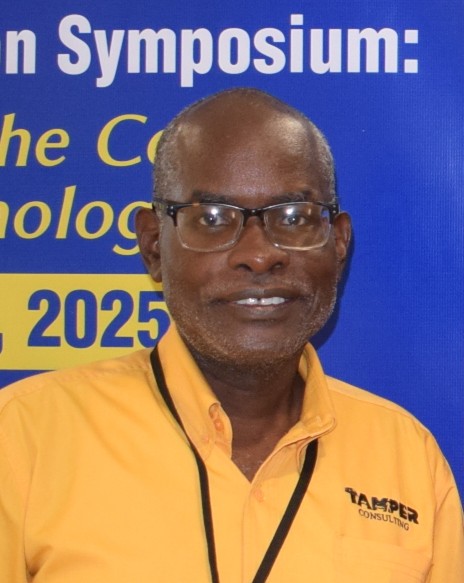
Kenute Hare has spent over 26 years addressing the needs of all road users in the traffic environment, with special focus on those who are the most vulnerable. As micromobility has emerged as a new road safety issue in developing countries such as Jamaica, he has initiated the development of policy frameworks to regulate the operation of these vehicles in the traffic environment, especially pertaining to e-bikes.
He is highly knowledgeable about the issues that must be addressed to ensure that micromobility users are provided with the necessary safety guardrails so they are not placed at increased risk from heavier vehicles that traverse the road network. He is an ardent supporter of shared road use, as well as appropriate separation where needed, thereby reducing exposure and conflict between smaller micromobility devices and larger vehicles.
Ms. Selika Josiah Talbott:
Topic: In-Vehicle Technology

Topic: In-Vehicle Technology
As the Founder and CEO of Autonomous Vehicle Consulting, Selika Josiah Talbott is a leading industry voice for responsible investment, engagement, and preparation for New Mobility including robot delivery, autonomous and electric vehicles, and self-driven freight.
She began her career as a litigator in NYC, and has handled litigation for Vehicle Manufacturers in defense of their products in manufacturing and/or design defect cases.
Selika has served as the Deputy Administrator of the Motor Vehicle Commission for the State of New Jersey, and more recently, at the U.S Department of Transportation, Federal Motor Carrier Safety Administration as the Senior Advisor to the Administrator.
Mr. Wayneworth Hamilton:
Topic: Remote Data Collection

Topic: Remote Data Collection
Wayneworth Hamilton is a distinguished Jamaican Commissioned and Chartered Land Surveyor, Senior Director at the National Land Agency (NLA), former Director of the Surveys & Mapping Department in the Turks & Caicos Islands, and former lecturer at the University of Technology, Jamaica.
He is recognised for his expertise in cadastral systems and digital mapping and is a respected figure in Caribbean land administration.
Wayneworth Hamilton is a highly qualified and influential land professional in the Caribbean, combining technical expertise with transformational leadership.
Regional Transport Research Conference:
Perspectives on Conflict in Transport and Mobility
In 2026, the conference will continue to have a relatively wide scope and breadth, with a view to involving practitioners and researchers from a range of backgrounds and experience to participate as presenters, panelists and attendees. The focus on research as a key aspect of industry development remains, and the joining of industry and academia will serve to enrich both areas and the transport sector overall.
Wide regional representation is expected, and strong participation from members of the Caribbean diaspora and others from the Global South is also anticipated.
The mixed delivery format used in 2025 will be retained so that engagement and participation can be maximised, with six panel discussions and eight presentation tracks.
Themes and tracks are preliminary, and the agenda may not include all the indicative areas once the scope of topics selected for presentation is finalised.
The scope is indicated in the tables below; these themes and tracks may cover any of the conceptual issues listed, in addition to others that may be introduced during ongoing consultations. The final agenda topics will be curated and refined based on interest areas that may be highlighted by persons who are participating.
PANELS
| Theme/Track | Potential Areas of Focus |
|---|---|
| Travel and Transport Security | Individual and collective risk in transport systems; exposure during travel by different modes; border control and screening |
| Integrity and Accountability | Ethical issues in transport; compliance; quality of systems, services and operations; infrastructure forensics and audit |
| Education | Transportation training; travel experience and student performance; spatial distribution of institutions |
| Financing Transport | Role of government versus private sector; user fees and charges; operational costs |
| Multimodal Systems | Intermodal facilities; integration of services; competition between modes |
| Agriculture and Food Security | Accessibility of farms; transport of agricultural products; international trade (import/export); development impact |
PRESENTATIONS
| Theme/Track | Potential Areas of Focus |
|---|---|
| Infrastructure | Roads, highways, airports, seaports, transport centres, depots, navigation tools, construction materials |
| Operations | Tolls, public transport, rail, aviation, traffic management, ports, licensing |
| Resilience | Climate risk, infrastructure and service restoration, natural hazards, competition |
| Legislation | International conventions, public education, enforcement, planning and development, amendments, interpretation |
| Externalities | Pollution, disruption, medical impacts, environmental degradation, injustice, accessibility |
| Technology | Monitoring and surveillance, evaluation and modelling tools, artificial intelligence, communication systems, drones and eVTOLS, GPS and GIS, electric vehicles |
| Safety | Collisions and fatalities, risk and exposure, planning and design, safety features |
| Micromobility | Walking, cycling, scooters, inclusiveness, societal benefits, facilities, shared spaces |
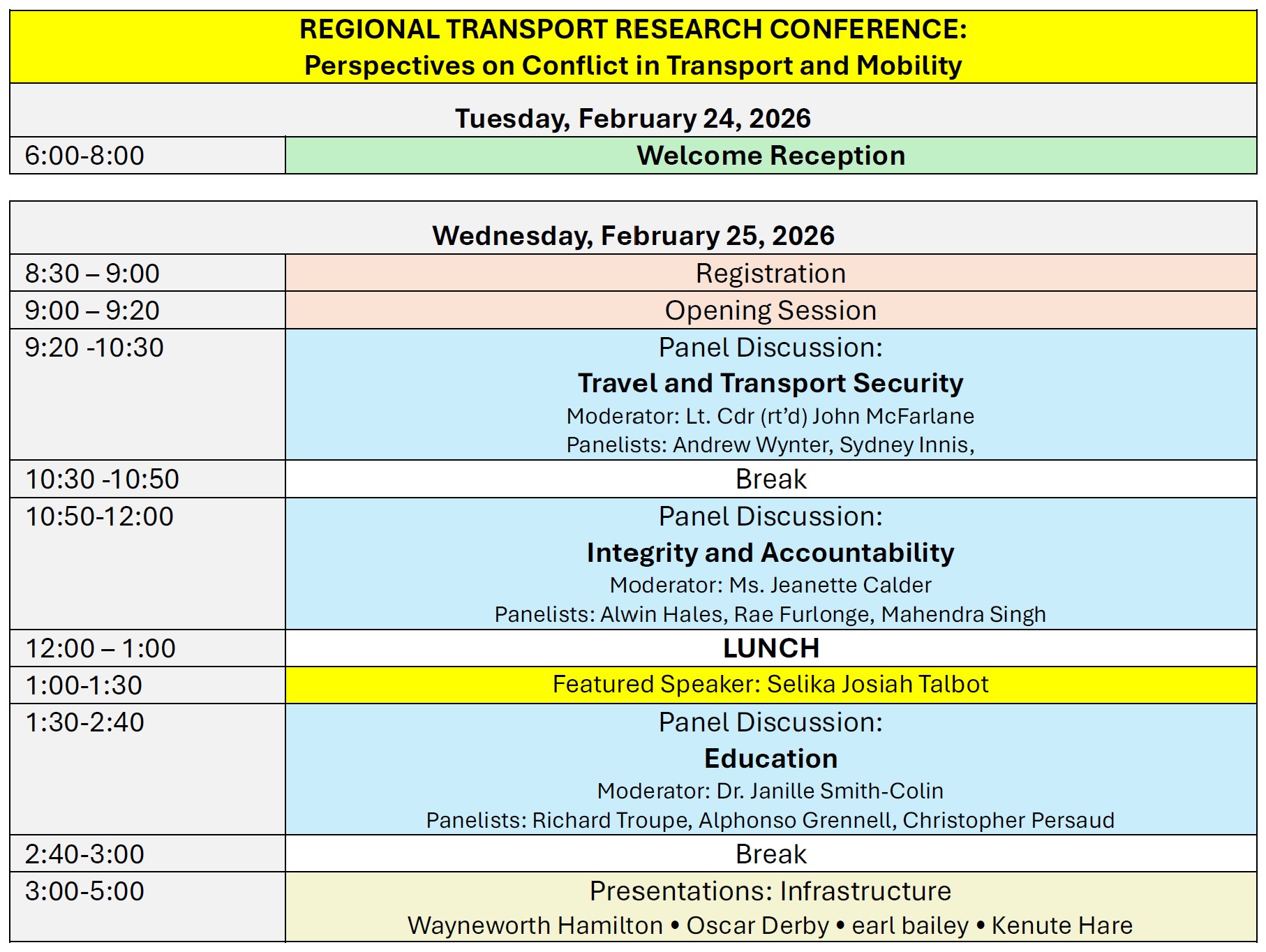
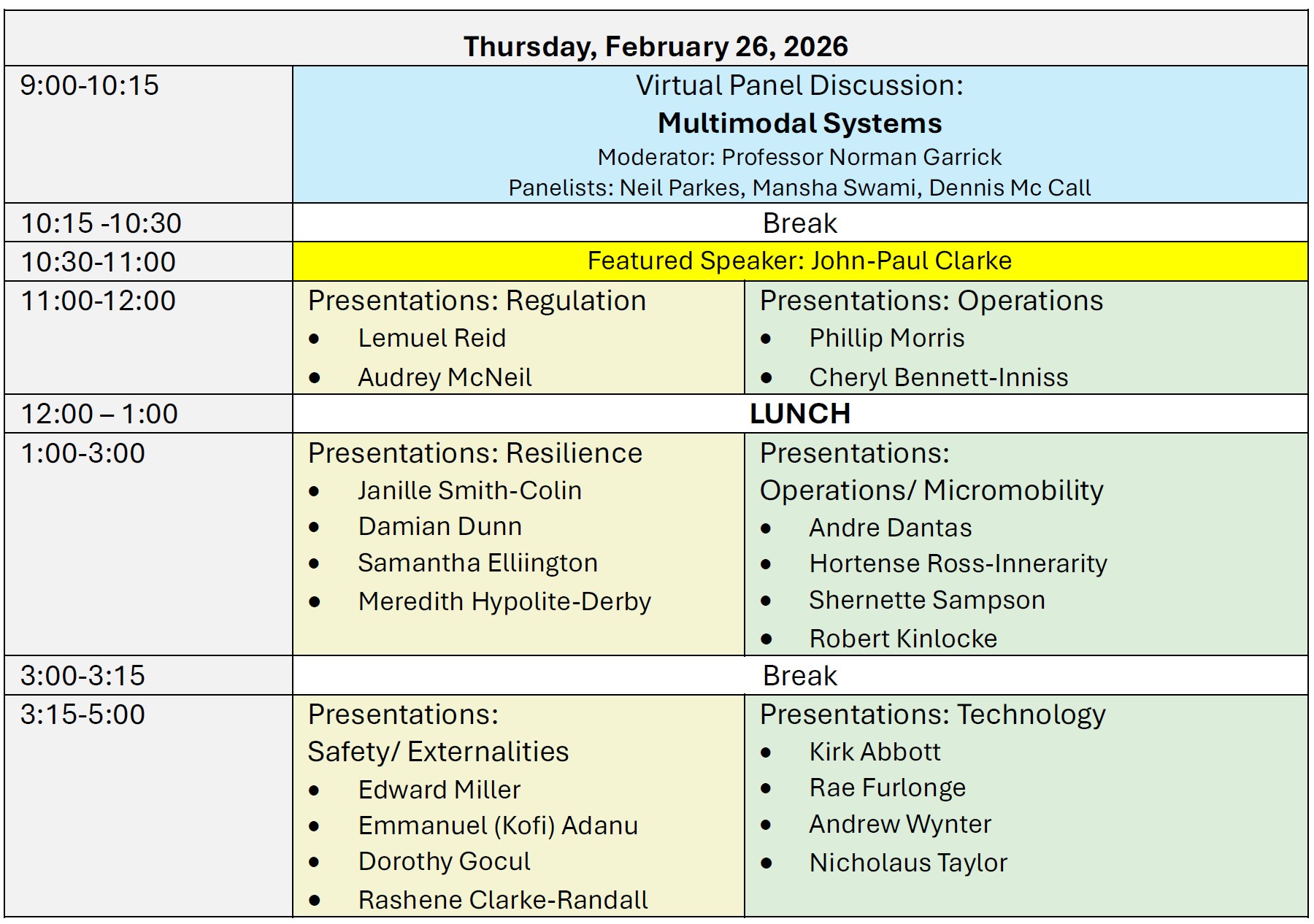
RTRC Preliminary Agenda
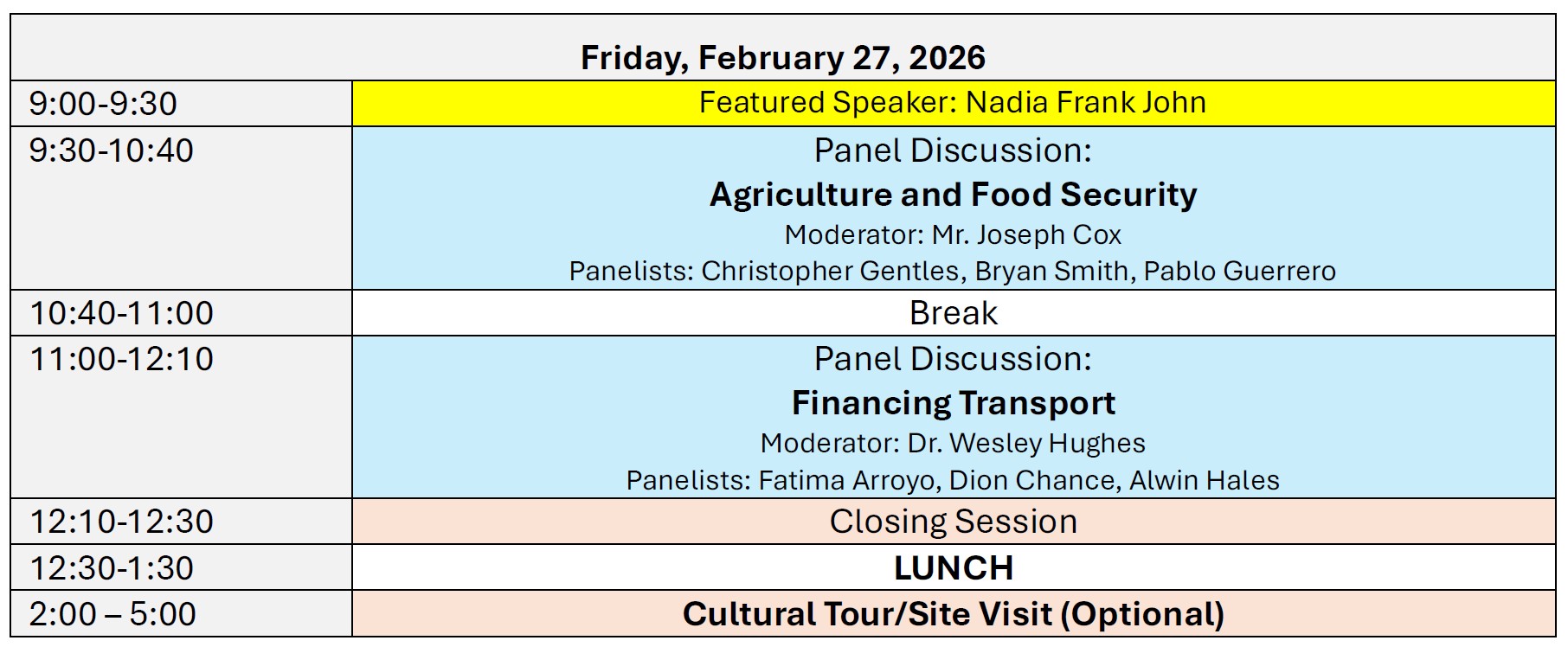
Featured Speakers
Dr. John-Paul Clarke:
Topic: Considerations for Development and Deployment of eVTOLs
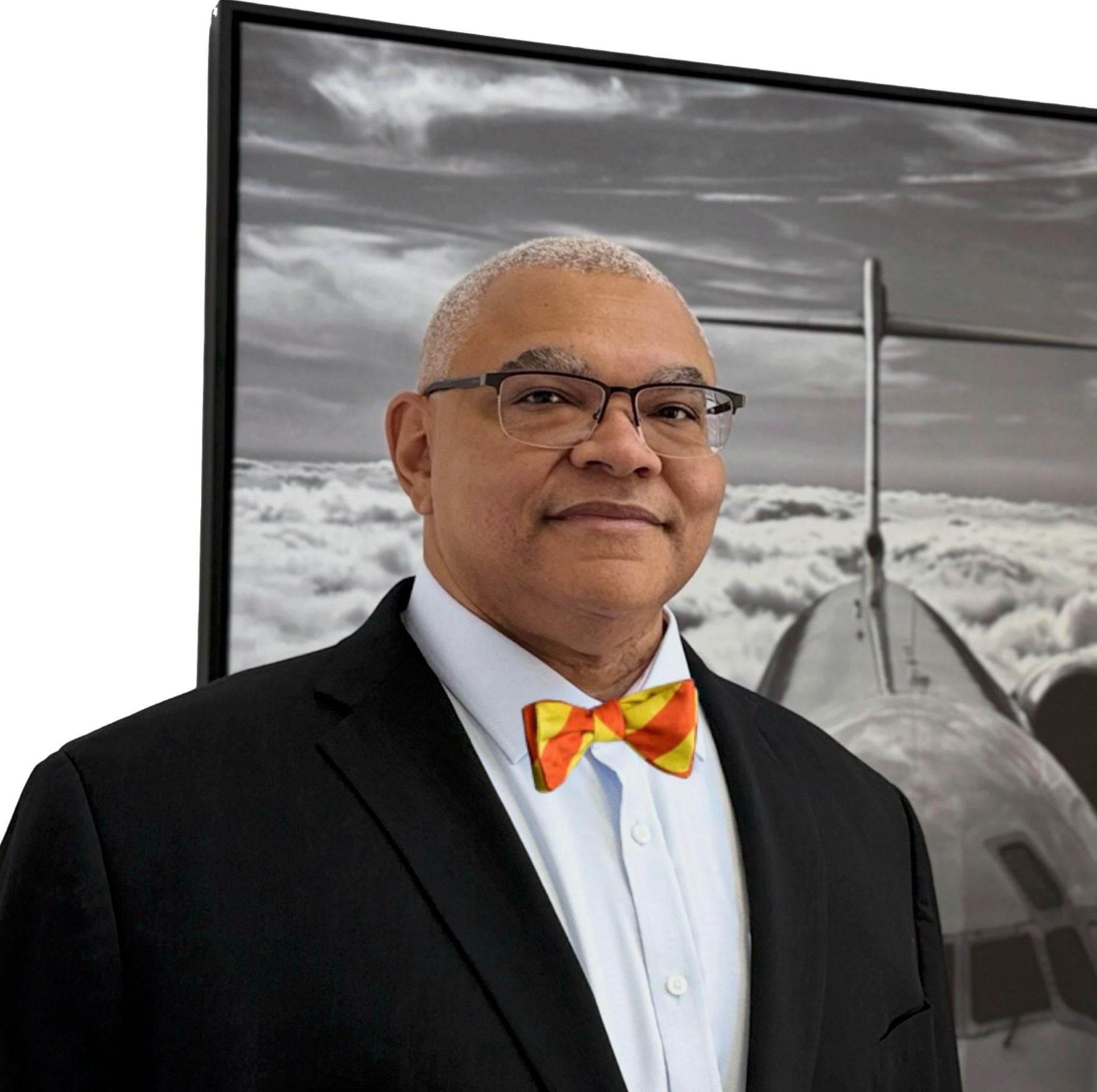
Topic: Considerations for Development and Deployment of eVTOLs
Dr. John-Paul Clarke is a professor of Aerospace Engineering and Engineering Mechanics at The University of Texas at Austin, where he holds the Ernest Cockrell Jr. Memorial Chair in Engineering. Previously, he was a faculty member at the Georgia Tech and MIT; the Vice President for Strategic Technologies at United Technologies (now RTX); and a researcher at Boeing and NASA JPL.
Prof. Clarke is an expert in the development and use of stochastic models and optimization algorithms to improve the efficiency and robustness of complex systems, with a particular focus on aviation. For example, his work has led to the development of fully autopilot-coupled continuous descent arrival procedures; airline schedules that are “robust” to poor weather and/or aircraft failures; algorithms to maximize the likelihood of success for a portfolio of research and development projects (or financial assets) with uncertain future performance and schedule; and finite-sample bounds for Q -learning with linear function approximation (in the field of reinforcement learning).
He received the S.B., S.M., and Sc.D. degrees from MIT in 1991, 1992, and 1997, respectively. He is a Fellow of the American Institute of Aeronautics and Astronautics (AIAA), the Airline Group of the International Federation of Operational Research Societies (AGIFORS), and the Royal Aeronautical Society (RAeS); and is a member of INFORMS and Sigma Xi. His many prior honors include the 1999 AIAA/AAAE/ACC Jay Hollingsworth Speas Airport Award, the 2003 FAA Excellence in Aviation Award, the 2006 National Academy of Engineering Gilbreth Lectureship, the 2012 AIAA/SAE William Littlewood Lectureship, and the 2015 SAE Environmental Excellence in Transportation Award.
Mrs. Nadia Frank John:
Topic: Unsafe School Access in Vulnerable Communities

Topic: Unsafe School Access in Vulnerable Communities
Nadia Frank John is a Transportation Planner with the Tobago House of Assembly and the Director of the Caribbean Mobility and Resilience Initiative (CMRI), a nonprofit organization dedicated to advancing sustainable mobility and climate resilient transportation solutions across the Caribbean.
Driven by a commitment to resilient and equitable transportation systems, Nadia aims to influence regional policy development while promoting sustainable practices that benefit both people and the environment. Her expertise spans sustainable mobility research, urban planning, climate resilience, and transport policy, making her a key voice in shaping the future of Caribbean transportation systems.
Ms. Selika Josiah Talbott:
Topic: Mobility is a Human Right; Call for a Mobility Czar

Topic: Mobility is a Human Right; Call for a Mobility Czar
As the Founder and CEO of Autonomous Vehicle Consulting, Selika Josiah Talbott is a leading industry voice for responsible investment, engagement, and preparation for New Mobility including robot delivery, autonomous and electric vehicles, and self-driven freight.
She began her career as a litigator in NYC, and has handled litigation for Vehicle Manufacturers in defense of their products in manufacturing and/or design defect cases.
Selika has served as the Deputy Administrator of the Motor Vehicle Commission for the State of New Jersey, and more recently, at the U.S Department of Transportation, Federal Motor Carrier Safety Administration as the Senior Advisor to the Administrator.
Dr. Andre Dantas:
Topic: Business Collaboration Mobility Model

Topic: Business Collaboration Mobility Model
Dr. Dantas is an internationally recognised professional working on various facets of transport engineering. Over the last 32 years, Dr. Dantas has gathered experience in academia, public service, consultancy, policy think tank and fintech sectors around the world (Australia, Brazil, China, Japan, New Zealand, UK and USA).
Dr. Dantas has recently acted as the head of the local transport authority of the 3rd biggest urban area of Brazil, which is Belo Horizonte. Since 2022, Dr. Dantas implemented massive transformation of the institutional, legal and operational frameworks that contributed to overcome the impacts of the COVID-19 pandemic.
Currently, he is acting as an independent consultant providing specialized services to various clients, including the Asian Infrastructure Investment Bank (AIIB), transport companies and government agencies.
Logistics for Participants
VENUE
Hotel Four Seasons is conveniently located at 18 Ruthven Road in New Kingston. The Summit Kingston is also located in New Kingston at 16 Chelsea Avenue, and is accessible from Ruthven Road. As Jamaica's 1st green business and lifestyle complex, this venue hosts flexible work and business spaces, recreational and business events, and is a natural hub for networking that provides both locals and visitors with an authentic taste of Kingston's culture.
Refreshments and lunch will be provided for participants during the events.
ACCOMMODATION
Participants will be responsible for arranging their own accommodation. For the greatest convenience of access to the conference sessions, participants may choose to book rooms nearby in New Kingston and the surrounding area, where several options including hotels, guest houses, and AirBnBs, are available. For convenience, a block of rooms has been reserved at the Hotel Four Seasons.
Notwithstanding, participants should review and consider the available options before making their own hotel arrangements. Other hotels that may be considered are:
- AC Hotel, 38-42 Lady Musgrave Road, Kingston 5
- Courtleigh Hotel & Suites, 85 Knutsford Boulevard, Kingston 5
- Jamaica Pegasus, 81 Knutsford Boulevard, Kingston 5
- Marriott Courtyard Kingston, 1 Park Close, Kingston 5
- R Hotel, 2 Renfrew Road, Kingston 5
- S Hotel Kingston, 1 St. Lucia Avenue, Kingston 5
- Terra Nova All Suite Hotel, 17 Waterloo Road, Kingston 10
TRAVEL
There are several airlines that offer service to Jamaica from North America and the region, to both Kingston or Montego Bay. The Knutsford Express provides a comfortable and reliable service for transportation from Montego Bay to Kingston.
The event organisers will arrange transportation for participants to and from the field activities/site visits.
Registration & Pricing
Registration fees for attendees, presenters and students are set out in the table below. A group discount may be applied for delegations comprising not less than 5 persons from any entity.
| Attendee Type | CTCIS | RTRC | BOTH EVENTS |
|---|---|---|---|
| Attendee | J$85,000 / US$600 | J$85,000 / US$600 | J$150,000 / US$1100 |
| One-day | J$45,000 / US$350 | J$35,000 / US$250 | N/A |
| RTRC Presenter | J$75,000 / US$550 | J$35,000 / US$250 | J$110,000 / US$800 |
| Student | J$30,000 / US$220 | J$20,000 / US$150 | J$40,000 / US$300 |
Registration fee includes access to all sessions, the cocktail reception on February 24th, refreshments, and lunch during the event.
Abstract Submission
Abstracts will continue to be accepted until the programme is finalised in January. Abstracts for presentations and posters can be submitted using the portal on the TAMPER Consulting website (www.tamperconsulting.com) or using the Abstract Submission form below.
Queries about submissions should be sent to tamper@tamperconsulting.com, with the subject line being “Abstract Submission” followed by the author/presenter’s name.